
October 28, 2026

Five is a big year: most 5-year-olds can follow the rules of a game, count to 10, hop on one foot and tell you a story with a beginning and an end. The best toys for a 5-year-old give them room to practise all of that, ideally with you or a friend playing along. These nine screen-free picks, from $14.99 to $46.97, cover pretend play, building, letters and numbers, first board games, active play, art and the outdoors. Each one is tied to a milestone or play tip from the CDC, and every one carries a maker age grade of 3 or older.
Quick list
The CDC lists milestones that most children (75% or more) reach by a certain age. By 5, most children follow rules or take turns when playing games with other children, sing, dance or act for you, and do simple chores like matching socks. They tell a story with at least two events, answer simple questions about a book, and use or recognize simple rhymes. Most count to 10, name some numbers between 1 and 5 and some letters when you point to them, write some letters in their name and pay attention for 5 to 10 minutes during activities such as story time or arts and crafts. On the move, most button some buttons and hop on one foot.
The CDC's play tips for this age are practical: play simple board games, card games or Simon Says to teach rules; play with puzzles and building blocks; play rhyming games; keep crayons, paper, paint and glue on hand; encourage pretend play; and make time for active play every day. It also suggests limiting screen time to no more than 1 hour a day.
An American Academy of Pediatrics clinical report says the toys that matter most are the ones that get caregivers and children playing together, in play that is rich in language, pretending, problem-solving and creativity, and it notes a lack of evidence that digital "toys" offer the same benefits as traditional ones. So we chose hands-on toys you can play with your child, spread across the areas the CDC highlights for this age. We checked each listing on Amazon on the morning of Oct. 26, 2026, for the age grade, the safety warning, the price and stock. None of these products has been featured in our earlier age guides.
A safety note before you shop: every pick below has a maker age grade of 3 or older, and every listing carries a "CHOKING HAZARD, small parts, not for children under 3" warning. If you have a baby or toddler at home, store these up high after play. Two picks use batteries (one button battery and one set of AA batteries) and one includes magnetic letters. The American Academy of Pediatrics' safe-toy advice says to read the label and to look out for button batteries, high-powered magnets and other small objects that young children might put in their mouths.
1. Learning Resources Pretend & Play Calculator Cash Register, 73 pieces (ages 3 to 5)

Playing store mixes two things the CDC suggests for 5-year-olds: pretend play (it recommends helping your child find items to play dress-up, school or house) and numbers (most 5-year-olds count to 10 and name some numbers between 1 and 5). Your child rings up groceries, takes payment and hears the drawer go "ka-ching." The calculator is solar-powered, and the 73-piece set includes a pretend credit card, per the listing. The listing shows about 4.7 stars from about 22,100 ratings.
Age and safety: manufacturer's recommended age 3 to 5 years, so this one suits a younger 5-year-old best. The listing warns: CHOKING HAZARD, small parts, not for children under 3. Battery note: the listing's directions say to insert the included LR44 battery, which is a button battery, while another line in the same listing says batteries are not required for the solar calculator. Check that the battery compartment is closed tight before play. The American Academy of Pediatrics advises making sure battery compartments are secure and taped shut, and keeping spare button batteries locked away.
Price: $34.97 on Amazon (Amazon price checked Oct 26)
Pros:
Cons:
2. Plus-Plus Basic Mix, 240 pieces (ages 5+)

Every Plus-Plus piece is the same small double-plus shape, and they lock together into flat mosaics or 3D models. The CDC's play tips for 5-year-olds include toys that encourage your child to put things together, such as puzzles and building blocks, and it suggests asking "Why?" and "How?" about what your child is building. These pieces are small (about 3/4 inch by 1/2 inch, per the listing), which gives fingers plenty of pinch practice. The tube comes with an idea booklet. The listing shows about 4.7 stars from about 4,500 ratings.
Age and safety: manufacturer's recommended age 5 to 15 years. The listing warns: CHOKING HAZARD, small parts, not for children under 3. No batteries or magnets.
Price: $17.99 on Amazon (Amazon price checked Oct 26)
Pros:
Cons:
3. ThinkFun Zingo! Sight Words (ages 4 to 7, 2 to 6 players)

A bingo-style game with a tile-dispensing "Zinger": slide it, two word tiles pop out, and whoever needs a word on their card calls it and grabs it. The CDC says most 5-year-olds name some letters when you point to them, and this is a playful way to look at letters and simple words together. The double-sided cards offer two levels of play, so it can grow with a beginning reader. The listing shows about 4.7 stars from about 8,100 ratings.
Age and safety: manufacturer's recommended age 4 to 7 years. The listing warns: CHOKING HAZARD, small parts, not for children under 3. No batteries.
Price: $22.99 on Amazon (Amazon price checked Oct 26)
Pros:
Cons:
4. Learning Resources Sum Swamp Addition & Subtraction Game (ages 5 to 10, 2 to 4 players)

Roll two number dice and an operation die, add or subtract, then move your swamp creature along a numbered path. It is a numbered race game, the type studied by Carnegie Mellon researchers: in their study, preschoolers from low-income families who played a simple numbered board game for four 15-minute sessions caught up with their peers on a number-estimation task, while a version with colors instead of numbers did not have that effect (Siegler and Ramani, 2008). The listing shows about 4.8 stars from about 5,700 ratings.
Age and safety: manufacturer's recommended age 5 to 10 years. The listing warns: CHOKING HAZARD, small parts, not for children under 3. No batteries.
Price: $21.48 on Amazon (Amazon price checked Oct 26)
Pros:
Cons:
5. Gamewright Outfoxed! Cooperative Whodunit Game (ages 5+, up to 4 players)
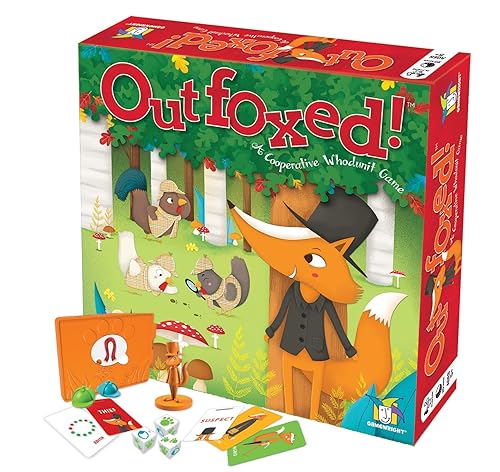
Players work as a team to figure out which fox is the thief before it escapes. You roll dice to move or reveal clues, then slide suspect cards into a decoder to rule foxes out. The CDC lists "follows rules or takes turns when playing games with other children" as a 5-year-old milestone and suggests teaching rules through simple board and card games. Because everyone wins or loses together, it is a gentle first step for kids who find losing hard. The listing shows about 4.8 stars from about 7,500 ratings.
Age and safety: the listing title says ages 5 and up; the manufacturer's recommended-age field reads 4 to 15 years. The listing warns: CHOKING HAZARD, small parts, not for children under 3. No batteries.
Price: $24.00 on Amazon (Amazon price checked Oct 26)
Pros:
Cons:
6. HABA Rhino Hero Stacking Card Game (ages 5+)

Players take turns folding wall cards and laying roof cards to build a wobbly tower, then move a little wooden Rhino Hero up the floors. The goal is to play all your cards before the tower falls. It practises steady hands, patience and taking turns, and the CDC notes that most 5-year-olds pay attention for 5 to 10 minutes during activities. Rounds are short enough to fit that. The box holds 31 roof cards, 28 wall cards, 1 foundation card and the wooden rhino. The listing shows about 4.7 stars from about 1,600 ratings.
Age and safety: manufacturer's recommended age 5 years and up. The listing warns: CHOKING HAZARD, small parts, not for children under 3. No batteries.
Price: $14.99 on Amazon (Amazon price checked Oct 26)
Pros:
Cons:
7. Liberty Imports Hopscotch Playmat, 10 foam number tiles (ages 3+)

Hopping on one foot is one of the CDC's movement milestones for 5-year-olds, and hopscotch turns it into a game. This mat is 10 interlocking 12-by-12-inch foam tiles numbered 1 to 10, with two place markers and a carry bag, per the listing, so it works indoors on a rainy day. Calling out numbers as your child lands adds counting practice. The CDC also suggests making time for active play each day. The listing shows about 4.6 stars from about 840 ratings.
Age and safety: manufacturer's recommended age 3 years and up. The listing warns: CHOKING HAZARD, small parts, not for children under 3. Use it on a clear, flat floor. No batteries.
Price: $24.95 on Amazon (Amazon price checked Oct 26)
Pros:
Cons:
8. Melissa & Doug Deluxe Double-Sided Magnetic Tabletop Easel (ages 3+)

A fold-flat wooden easel with a magnetic dry-erase side, a chalkboard side and a 50-foot paper roll, plus a dry-erase marker, eraser, five chalk sticks and 36 magnetic letters and numbers, per the listing. The CDC suggests keeping crayons, paper, paint, child scissors and glue on hand for creative play, and says most 5-year-olds write some letters in their name. The magnetic letters make spelling a name a game before writing it. The listing shows about 4.6 stars from about 1,900 ratings.
Age and safety: the listing title says ages 3+. The listing warns: CHOKING HAZARD, small parts, not for children under 3. The 36 letters and numbers are magnets, so keep them away from babies and toddlers. No batteries.
Price: $46.97 on Amazon (Amazon price checked Oct 26)
Pros:
Cons:
9. Nature Bound Bug Catcher Vacuum (ages 3 to 12)

Pull the trigger and a gentle vacuum pulls a bug into a clear capture core with a magnifier, so kids can look closely and then let it go. It has an LED light for evening hunts. The CDC suggests exploring what your child likes: if they love animals, look for birds and squirrels in a park or get library books about them. A bug hunt also gets your child outside, and asking what they found is an easy way to keep a conversation going. The listing shows about 4.2 stars from about 1,500 ratings.
Age and safety: manufacturer's recommended age 36 months to 12 years. The listing warns: CHOKING HAZARD, small parts, not for children under 3. It runs on AA batteries, which are not included, per the listing. Make sure the battery door stays closed.
Price: $24.99 on Amazon (Amazon price checked Oct 26)
Pros:
Cons:
You do not need to buy anything to follow the CDC's tips for 5-year-olds. Play Simon Says, I Spy or Hot and Cold. Ask "What rhymes with cat?" in the car. Sing a days-of-the-week song and use words like yesterday and tomorrow. Let your child match socks or clear the table, and try not to fix what they do. Read together and ask "What do you think will happen next?" At the playground, teach them to pump their legs on a swing. Playing with other children, at a park or library, is another CDC suggestion.
For more gift ideas, browse our Holiday Gift Guide for Ages 3 to 5 and Holiday Gift Guide for Ages 6 to 8. Shopping for a younger child? See our Best Toys for 4-Year-Olds 2026. For an older child, try our Best Gifts for 7-Year-Olds 2026.
Every child grows at their own pace. If your child is not meeting one or more milestones, has lost skills they once had, or you have other concerns, talk to your pediatrician. The CDC also lists each state's early intervention contacts at cdc.gov/FindEI.
For the full weekly market brief: The ToyDirectory Intelligence Report
Sources:
#ad As an Amazon Associate, TDmonthly earns from qualifying purchases. Prices and availability are as of Oct. 26, 2026 and may change.
Copyright © 2026 TDmonthly®, a division of TOYDIRECTORY.com®,
Inc.