The best toys for a 4-year-old let them do what most 4-year-olds love right now: pretend to be someone else, help with grown-up jobs, build things that work and play simple games with you. These seven screen-free picks, from $7 to $45, are each tied to a milestone or play tip from the CDC, and every one is rated 3+ by its maker.
Quick list
- Best for pretend play: Melissa & Doug Get Well Doctor Kit ($29.97)
- Best for little helpers: Melissa & Doug Dust! Sweep! Mop! ($31.30)
- Best building splurge: MAGNA-TILES Classic 32-Piece Set ($45.00)
- Best for tinkerers: Learning Resources Gears! Gears! Gears! Deluxe Set ($34.99)
- Best first counting game: Chutes and Ladders ($14.99)
- Best game for small hands: The Sneaky, Snacky Squirrel Game (about $22 to $24)
- Best under $10: Play-Doh Starter Set ($7.29)
What most 4-year-olds are learning to do
The CDC lists milestones that most children (75% or more) reach by a certain age. By 4, most children pretend to be something else during play (a teacher, a superhero, a dog), like to be a "helper," name a few colors, catch a large ball most of the time, pour water with an adult watching and hold a crayon between their fingers and thumb instead of in a fist.
The CDC's play tips for this age are refreshingly low-tech: give toys that encourage imagination, "such as dress-up clothes, pots and pans to pretend cook, or blocks to build with," let your child help with simple chores, count everyday things, and play simple games like matching games. It also suggests limiting screen time to no more than 1 hour a day of a children's program with an adult present.
Why we picked simple, hands-on toys
An American Academy of Pediatrics clinical report says the best toys are the ones that get caregivers and children playing together, and that traditional toys such as blocks, pretend-play sets, art supplies and board games are preferred over digital ones. None of the seven picks below needs batteries or a screen.
Board games have some of the most interesting research behind them. In a Carnegie Mellon study, preschoolers from low-income families who played a simple numbered board game for four 15-minute sessions caught up with their peers on a number-estimation task. The same game with colors instead of numbers did not have that effect (Siegler and Ramani, 2008). That is why a numbered race game like Chutes and Ladders is on this list.
A safety note before you shop: every toy below carries a manufacturer age grade of 3 or older, and most carry a "CHOKING HAZARD, small parts, not for children under 3" warning on the listing. If you have a baby or young toddler at home, store these up high after play. MAGNA-TILES also contain small magnets. The American Academy of Pediatrics' safe-toy advice says to read the label, make sure toys and parts are larger than your child's mouth, and be careful with toys whose magnets could come loose.
For pretend play and little helpers
1. Melissa & Doug Get Well Doctor Kit, 25 pieces (ages 3+)

"Pretends to be something else during play" is a CDC milestone for 4-year-olds, and a doctor kit is one of the easiest ways in: one day your child is the doctor, the next day the stuffed animals are patients. The set includes a stethoscope, blood pressure cuff, thermometer, pretend syringe and hearing tester in a carrying tote. The listing shows about 4.8 stars from about 8,900 ratings.
Age and safety: listing age 3 to 6 years; the manufacturer's minimum age is 3. No batteries, per the listing.
Price: $29.97 on Amazon (Amazon price checked Oct 25)
Pros:
- Built for role play, the big pretend-play milestone at 4
- Can make real check-ups feel more familiar
- Everything packs into its own tote
Cons:
- 25 pieces to keep track of
- Pricier than a homemade dress-up box
2. Melissa & Doug Dust! Sweep! Mop! 6-Piece Cleaning Set (ages 3 to 5)
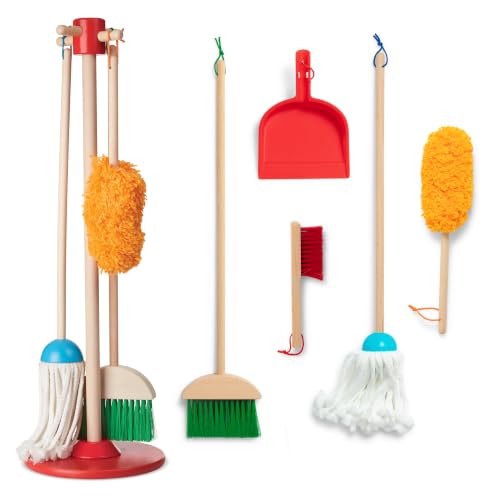
Most 4-year-olds like to be a "helper," and the CDC suggests letting them help with simple chores to build independence. This kid-size set includes a broom, mop, duster, brush and a dustpan that clips onto the handles, plus a wooden stand to keep it tidy. The listing shows about 4.8 stars from about 50,400 ratings.
Age and safety: listing age 3 to 5 years. The listing warns: CHOKING HAZARD, small parts, not for children under 3. No batteries.
Price: $31.30 on Amazon (Amazon price checked Oct 25)
Pros:
- Turns everyday chores into play you can do together
- Storage stand keeps the tools off the floor
- Very highly rated, with tens of thousands of reviews
Cons:
- It is a play set, not a real cleaning tool
- The stand takes up some floor space
For builders and tinkerers
3. MAGNA-TILES Classic 32-Piece Set (ages 3+)

Translucent magnetic squares and triangles in six colors that click together into towers, houses and garages. The CDC suggests blocks for this age, and building with shapes is a natural way to practise naming colors and shapes, which the CDC also recommends. The set includes 16 squares and 16 triangles and works with every other MAGNA-TILES set. The listing shows about 4.9 stars from about 13,900 ratings.
Age and safety: manufacturer's minimum age 3. The listing warns: CHOKING HAZARD, small parts, not for children under 3, and that the product contains small magnets, which can cause serious injury if swallowed. Inspect tiles for cracks and throw away any broken piece. No batteries.
Price: $45.00 on Amazon (Amazon price checked Oct 25)
Pros:
- Open-ended: the same tiles become a castle, a car ramp or a rainbow
- Easy for small hands to snap together and pull apart
- Grows with add-on sets from the same brand
Cons:
- The most expensive pick, and 32 tiles go fast with two builders
- Contains magnets, so keep it away from babies and toddlers
4. Learning Resources Gears! Gears! Gears! Deluxe Building Set, 100 pieces (ages 3 to 10)

Kids snap gears onto pillars and bases, then turn a crank and watch the whole chain spin. It is a hands-on way to explore cause and effect, and the wide age range means a 4-year-old can start with a simple row of gears and build bigger machines for years. The listing shows about 4.7 stars from about 4,700 ratings.
Age and safety: listing age 3 to 10 years; manufacturer's minimum age 3. The listing warns: CHOKING HAZARD, small parts, not for children under 3; CHOKING HAZARD, toy contains a small ball, not for children under 3; to be used under the direct supervision of an adult. No batteries.
Price: $34.99 on Amazon (Amazon price checked Oct 25)
Pros:
- Long life: fun at 4 and still useful in early grade school
- 100 pieces is plenty for siblings or a playdate
- Shows how one move makes another happen
Cons:
- Many small pieces to pick up, and the maker says to supervise
- Some 4-year-olds will need help getting started
For first board games
5. Hasbro Gaming Chutes and Ladders (ages 3+, 2 to 4 players)

Spin, count your spaces and race up a numbered board, climbing ladders and sliding down chutes. No reading is needed. This is the kind of numbered, in-a-row race game used in the Siegler and Ramani study, and counting spaces out loud fits the CDC tip to count simple things together. It is also a gentle way to practise taking turns and losing gracefully. The listing shows about 4.8 stars from about 12,000 ratings.
Age and safety: listing age 3 to 7 years. The listing's safety fields list a choking hazard for small parts (they also mention a marble), so keep it away from children under 3. No batteries.
Price: $14.99 on Amazon (Amazon price checked Oct 25)
Pros:
- Counting practice built into every turn
- No reading required, and games are short
- Under $15
Cons:
- Pure luck, so older siblings may get bored
- Sliding down a long chute can bring tears at first
6. Educational Insights The Sneaky, Snacky Squirrel Game (ages 3 to 7, 2 to 4 players)
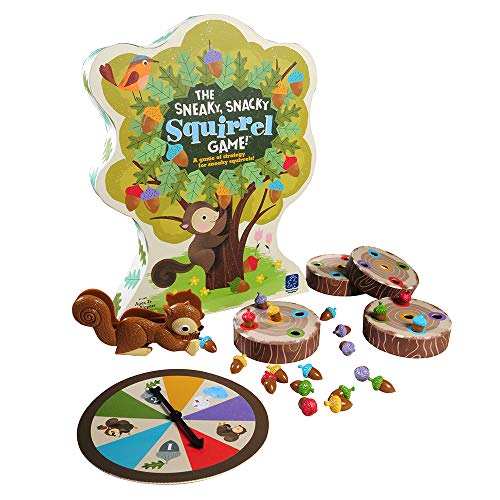
Spin the spinner, then use the squirrel-shaped squeezer to pick up a matching acorn and fill your log first. Naming colors is a CDC milestone at 4, and working the squeezer gives little fingers plenty of pinch-and-grip practice. The box doubles as the tree-shaped board. The listing shows about 4.8 stars from about 11,500 ratings.
Age and safety: listing age 3 to 7 years; manufacturer's minimum age 3. The listing warns: CHOKING HAZARD, small parts, not for children under 3. It is a manual game with no electronics (the listing's spec table shows a battery entry, but the included parts are a board, squeezer, 20 acorns, a spinner and four logs).
Price: About $22 to $24 on Amazon (Amazon price checked Oct 25; it showed $21.74 on the product page and $23.76 in Amazon's product data the same morning)
Pros:
- Color matching plus fine-motor practice in one game
- Quick setup, because the box is the board
- A favorite with preschool families, judging by the reviews
Cons:
- The small acorns are easy to lose and a hazard for younger siblings
- Spinner luck decides a lot
For busy hands
7. Play-Doh Starter Set, 9 tools and 4 cans (ages 3+)

Rolling, cutting and stamping dough is a classic way for preschoolers to use their hands, and it pairs well with pretend cooking, another CDC idea for this age. The kit has a roller, cutters, plastic scissors and knife, and four 2-ounce cans in a reusable tote. The listing shows about 4.8 stars from about 10,300 ratings.
Age and safety: manufacturer's minimum age 3. The listing warns: CHOKING HAZARD, small parts, not for children under 3. The compound contains wheat and is not intended to be eaten, which matters for families avoiding gluten. No batteries.
Price: $7.29 on Amazon (Amazon price checked Oct 25)
Pros:
- The least expensive pick and an easy stocking stuffer
- Endless open-ended play
- Travel tote keeps the tools together
Cons:
- Colors get mixed and dough dries out if the lids are left off
- Contains wheat
Free ideas that work just as well
You do not need to buy anything to follow the CDC's tips for 4-year-olds. Hand over pots, pans and a wooden spoon for pretend cooking, ask your child to help feed a pet or wipe the table, count bananas at the store, and play red light, green light or freeze dance to practise stopping and waiting. Reading together and asking "What do you think happens next?" is another CDC suggestion.
For more gift ideas for this age group, browse our Holiday Gift Guide for Ages 3 to 5. Shopping for a younger child? See our Best Toys for 2-Year-Olds 2026.
If you have questions about development
Every child grows at their own pace. If your child is not meeting one or more milestones, has lost skills they once had, or you have other concerns, talk to your pediatrician. The CDC also lists each state's early intervention contacts at cdc.gov/FindEI.
For the full weekly market brief: The ToyDirectory Intelligence Report
Sources:
#ad As an Amazon Associate, TDmonthly earns from qualifying purchases. Prices and availability are as of Oct. 25, 2026 and may change.