TDmonthly Magazine

TDmonthly's 2009 Holiday Gift Guide
July 2004 | Vol. III - No. 7
OR
Advanced Search

Advertisement:

Article Tools:
Supplier of the Month:Cloud B
Suppliers in the category of "Infant & Toddler"
Shop for Toy Products in the category of "Infant & Toddler"

Bad News About TV Means Good News for the Toy Industry, IF...


The news about television’s effect on children’s attention span created quite a stir this spring. Negative press about video content, and even the television medium itself, just keeps on coming. Warnings from child development experts about the relationship between television-watching and attention disorders started as early as 1979, but were largely ignored. The American Academy of Pediatrics recommended severely restricting television-viewing by young children in 1999, which again had little impact.

This past April, however, hard evidence about television’s negative effects on attention was reported in the journal Pediatrics, and the media buzzed with the news. The article about a study of nearly 1,500 children revealed problems in concentrating, thinking clearly, and in restless and impulsive behavior. Considering that 25% of all toddlers have a television in their bedrooms, and nearly half of all toddlers watch television every day, the attention and behavior problems stand to exceed epic proportions.

Caring parents will want to fire their “electronic babysitters” and find other ways to amuse and develop their young. They will likely purchase more toys to replace time currently occupied by television. Most importantly, they will seek more education about toys, as well as manufacturers’ assurances about the impact of toys.

The toy industry has an opportunity, and some might suggest a responsibility to develop ways to counteract television’s negative effects on children who have already watched television too early, and to attract children away from television. Toy manufacturers and retailers can gain in trust and reputation by understanding the implications of these current trends and assisting parents.

A Too-brief Primer

The young child’s developing brain needs more interaction and less stimulation than television can provide. Neurons grow at a rapid rate, and become part of an intricate network of connections through experience. The development of neurons and networks heavily influences the ability to learn and interact with the environment. The rapid-fire pace of images on television is a “double whammy”: it overstimulates the neurons as well as prevents a connection to meaning. Television is a passive medium—it requires no viewer action in order to gain the attention of a mind.

Constructive and Counteractive Toys

The tide of concern over television implies a growing market for two types of products, constructive and counteractive. Constructive toys build memory and attention, and foster the development of meaning in the child’s environment. Counteractive toys balance or undo the damage already done by watching television. They would be interactive and slow-paced.
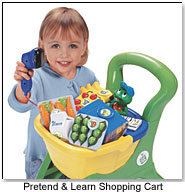
Good examples of counteractive toys are the 8-in-1 Adjustable Playground by Little Tikes, and the Pretend and Learn Shopping Cart by LeapFrog. Constructive toys include particular board games such as Concentration, K’NEX construction kits, and puzzles such as the Tangoes line by Rex Games.

In sum, the latest hard evidence on television and its effect on children’s development can greatly influence the creation and sale of toys. If the past is any predictor of the future, more hard evidence is coming. Will the toy industry respond?



Catalog Request Form

Read what more than 400 retailers have told TDmonthly about toys since 2005 in Toy-Store Owners Talk to TDmonthly.

Susan Hardwicke, Ph.D.Writer's Bio: Dr. Hardwicke is a psychologist specializing in measurement, assessment, and cognitive development. One of the pioneers in online educational testing, Dr. Hardwicke has also founded kSERO Corporation, Inc. (www.cognitivepix.com) to develop the human capacity to learn. kSERO Corporation recently received a federal grant to pursue its innovative approach to cognitive learning. Read more articles by this author


Reader's Comments

by knowingandgrowing.com on October 11, 2004

In April 2004, the American Academy of Pediatrics (AAP) published a study by Dr. Dimitri Christakis from the University of Washington. His study investigated a relationship between early childhood television viewing and attentional problems like attention deficit hyperactivity disorder (ADHD) in later childhood. Based on the Christakis study and previous AAP television viewing recommendations, the mainstream news media have fuelled a general misunderstanding on the subject in articles with sensationalist headlines like: "Too Much TV Spells ADHD" and "Toddler TV Time May Shorten Attention Spans". The authors of the Christakis study themselves made the following clarification about their findings: "... we cannot draw causal inferences from these ***ociations. It could be that attentional problems lead to television viewing rather than vice versa..." According to peer reviews of the Christakis study , the conclusions made were flawed due to the data the findings were based on. In particular, the study''s reliance on comments from parents about the nature of their children''s viewing habits and the lack of any clinical diagnosis of attentional problems like ADHD. In the Christakis study, the content or "quality" of the viewed material was not addressed. No distinction was made between general broadcast television viewing or video content viewing. In an interview about his study, Christakis had this to say on the nature of typical televised material: "Our hypothesis is that it''s the rapidity of image-change that''s potentially damaging to children''s brains..." General broadcast television programming tends to employ fast-paced editing, constant scene changes and an array of visual and audio techniques designed to grab the viewer''s attention as program-makers and the TV networks compete for audience ratings and advertisers vie for market-share. In the absence of selective parent supervision, general broadcast television does not provide parents with any real degree of control over the content or the nature of the images that might appear in front of their children at any time in a program, news bulletin or commercial break. Alternatively, productions like Knowing & Growing''s "Magical Nature Journey" DVD give parents complete control over the content and nature of the material their children are viewing. This production has been specifically developed for young viewers to provide them with high-quality educational content that is delivered in a gentle, soothing and effective way. Parent-child participation is recognized as an essential and integral component of the educational process. Parents and caregivers, by design, are included in the process and encouraged to be actively involved in sharing the learning experience with their children to further foster positive parent-child bonding. In conclusion, in their own article entitled "Television and the Family", the American Academy of Pediatrics states: "Learning - Television affects how your child learns. High-quality, nonviolent children''s shows can have a positive effect on learning. Studies show that preschool children who watch educational TV programs do better on reading and math tests than children who do not watch those programs. When used carefully, television can be a positive tool to help your child learn."


What do you think? Tell us.

Name

Comment


This security feature helps prevent automated programs from posting inappropriate comments.

Please enter the security code in the text box before you press "submit".

Code Image - Please contact webmaster if you have problems seeing this image code Load New Code
If you encounter any problems with this feature, please email us questions or comments.
Powered by Web Wiz CAPTCHA v 2.01 Copyright ©2005-2006 www.webwizcaptcha.com

Popular Stories

Request Information


Back to TDmonthly's front page

Advertisement:

Advertise on TDmonthly


Recent Products

Animal Daysack - Turtle
By LITTLELIFE
» More Information

» More Information

Young Minds - Numbers and Counting DVD
By MATH TUTOR DVD
» More Information


Related Articles
·Retailer Spotlight: Pufferbellies Toys & Books for Children
(11/1/2009)
·My Best Sellers: Pufferbellies Toys & Books
(11/1/2009)
·Video Highlights of the 2009 ABC Kids Expo
(10/1/2009)
·Simple Toys Teach Best
(2/1/2007)
·Barbie B-Creative Education Center
(1/1/2004)
·A Game For All Equations
(8/1/2004)


Advertisement:


TDmonthly ToyShow Preview


Magazine Home   Toy Fair Highlights   Contact TDmonthly  Toy Gallery   Advertise Here 
Editorial Calendar   Events & Trade Shows   Media Kit   Request Product Information   PlayZak®

Look up Manufacturers at ToyDirectory.com®

Search

Subscribe - TDmonthly e-Newsletter

Disclaimer  Privacy Policy  Career Opportunities  Feedback
Use of this site constitutes acceptance of our Terms of Use.
Copyright © 2009 TDmonthly®, a division of TOYDIRECTORY.com®, Inc.