Stacking cups, block towers and the joy of knocking them down are more than a way to fill a rainy afternoon. When toddlers stack and build, they practise hand control, early math and spatial thinking, and they pick up new words when you talk about what they are making. Here is what the research and early-childhood experts say, plus five simple stacking and building toys for ages 6 months to 3 years.
When does stacking start?
Babies usually start by holding, banging and dropping blocks. Around the first birthday, most babies put something in a container, like a block in a cup, according to the CDC's milestone checklist. By 15 months, most toddlers stack at least two small objects, like blocks. The CDC's tip for that age is simple: you stack the blocks and let your child knock them down. By 2, the CDC suggests taking turns building towers and knocking them down together.
An article for NAEYC by Rebecca Parlakian of ZERO TO THREE describes the same path. Starting at about 1 year old, children discover that flat-sided objects invite stacking, and between about 1 and 2½ years, toddlers who have plenty of chances to play with blocks quickly go from stacking two blocks to eight or more. Knocking towers down is part of the learning too: it is a cause-and-effect experiment toddlers love to repeat.
Remember that these are typical ranges, not deadlines. CDC milestones describe what most children (75% or more) can do by a certain age, and every child moves at their own pace.
What toddlers practise when they stack and build
Hand control. Picking up a block, lining it up and letting go gently takes careful hand and eye teamwork. Stacking cups and rings add a second challenge: putting things in order by size.
Early math and spatial thinking. In a University of Delaware and Temple University study of 102 three-year-olds, children who were better at copying interlocking block models also tended to score higher on early math, even after accounting for other factors (Verdine and colleagues, Child Development, 2014). The study shows a link, not proof that blocks cause better math scores, but it fits a wider body of research. In a separate University of Chicago study, toddlers who played with puzzles between about 2 and 4 years old did better on a spatial task at 4½, again a link rather than proof (Levine and colleagues, 2012).
Words. In a small pilot trial, researchers at the University of Washington gave building blocks to families of toddlers aged 1½ to 2½. In the low-income families, children who received blocks scored higher on a parent-reported vocabulary measure than children who did not; across the whole group, the difference was not statistically significant (Christakis and colleagues, 2007). The authors called for more research, so treat this as promising rather than settled.
Talking about space. Building gives you natural reasons to use words like on top, under, next to, tall and short. In a study that followed 52 families from 14 to 46 months, toddlers who heard more of these spatial words used more of them, and children who used more spatial words did better on spatial problem-solving tasks at 4½ (Pruden, Levine and Huttenlocher, 2011).
Patience and problem-solving. Towers fall. Toddlers learn that they can try again, put the big block on the bottom, or build wider instead of taller.
How to make block play count (it's mostly free)
- Narrate. "You put the red block on top of the blue one!" Simple descriptions add color, shape, size and position words.
- Take turns. You build, they knock down. Then switch.
- Use what you have. Plastic cups, food boxes and measuring cups stack just as well as store-bought toys.
- Keep it simple. The American Academy of Pediatrics says the best toys are the ones that get caregivers and children playing together, and that traditional toys such as blocks are preferred over digital ones. None of the toys below needs batteries.
- Put away the screens. The CDC says screen time is not recommended for children younger than 2, other than video calls with loved ones.
Five stacking and building toys for babies and toddlers
Every pick below is in stock, needs no batteries and is grouped from youngest to oldest by the manufacturer's age grade on the listing.
1. The First Years Stack & Count Stacking Cups, 8 cups (listing age 6 months to 2 years)

Eight bright cups that nest, stack and pour, with numbers on the bottoms and drain holes for bath or water-table play. The listing shows about 4.8 stars from about 92,700 ratings.
Age and safety: listing age 6 months to 2 years (the feature text says 9 months and up). The listing shows no warning for this product. No batteries.
Price: $7.45 on Amazon (Amazon price checked Oct 25)
Pros:
- Stacking, nesting and size order in one cheap toy
- Doubles as a bath and sand toy
Cons:
- A simple design that older 2-year-olds may outgrow
2. Fisher-Price Baby's First Blocks & Rock-a-Stack Set (listing age 6 months+)

Two classics in one box: a five-ring stacker on a rocking base, plus a bucket of 10 chunky blocks with a shape-sorter lid for put-in-and-dump-out play. The listing shows about 4.8 stars from about 26,600 ratings.
Age and safety: listing age 6 months and up. No small-parts warning shown on the listing. No batteries.
Price: $18.84 on Amazon (Amazon price checked Oct 25)
Pros:
- Matches the "block in a cup" stage around the first birthday
- Ring stacker adds size-order practice
Cons:
- Skews young, so most 2-year-olds will be ready to move on
3. MEGA BLOKS First Builders Big Building Bag (listing age 1 to 5)

Big, easy-grip blocks that click together, a good next step for toddlers who are ready to build rather than just stack. They come in a storage bag. The listing shows about 4.8 stars from about 132,000 ratings.
Age and safety: listing age 1 to 5 years. The listing says: not for children under 1 year of age. No batteries.
Price: $14.97 on Amazon (Amazon price checked Oct 25)
Pros:
- Sized for toddler hands and easy to pull apart
- Bag makes cleanup quick
- Under $15
Cons:
- The title says 80 pieces while the feature list says 60 blocks, so the count may include the bag and extras
4. LEGO DUPLO Classic Brick Box 10913, 65 pieces (listing age 18 months+)
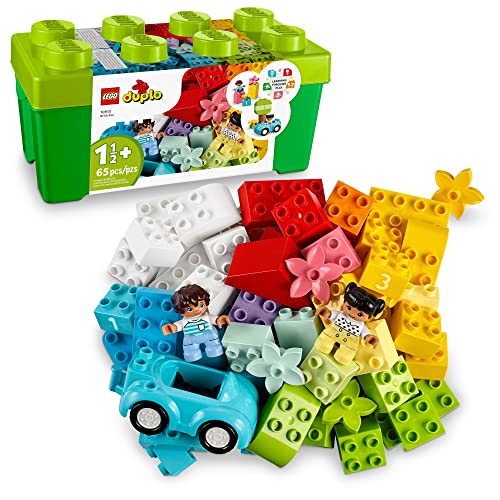
Chunky bricks plus a toy car, windows, flowers, two figures and 1-2-3 number bricks, so building can turn into pretend play. The listing shows about 4.9 stars from about 12,700 ratings.
Age and safety: listing age 18 months and up. No small-parts warning shown on the listing. No batteries.
Price: $23.95 on Amazon (Amazon price checked Oct 25)
Pros:
- Building and pretend play in one set
- Works with later DUPLO sets
Cons:
- Rated 18 months+, so it is a grow-into gift for a 1-year-old
- Pricier than plain blocks
5. Melissa & Doug 100 Wooden Building Blocks (listing age 2+)

Classic solid-wood blocks in four colors and nine shapes, stored in a cardboard box with a handle. Plain blocks like these are the ones toddlers knock down, line up into trains and stack into bridges. The listing shows about 4.8 stars from about 28,700 ratings.
Age and safety: listing age 24 months to 8 years. No small-parts warning shown on the listing. No batteries.
Price: $13.99 on Amazon (Amazon price checked Oct 25)
Pros:
- 100 blocks for under $15
- Lasts from toddlerhood into early grade school
Cons:
- Wooden blocks are loud when towers crash on hard floors
- Comes in a cardboard box rather than a sturdier bin
Keep building as they grow
Looking for more toys matched to your child's age? See our Best Toys for 18-Month-Olds 2026 and Best Toys for 2-Year-Olds 2026. For preschoolers ready for magnetic tiles and gears, our new Best Toys for 4-Year-Olds 2026 guide in the Best Toys by Age section has picks rated 3+, and our Holiday Gift Guide for Ages 3 to 5 has more.
A note on safety and development
Read the label: the American Academy of Pediatrics advises making sure all toys and parts are larger than your child's mouth. Keep building sets rated 3+ (and their small pieces) away from babies and toddlers. If you have questions about how your child is stacking, playing or talking, or about any milestone, talk to your pediatrician. The CDC also lists each state's early intervention contacts at cdc.gov/FindEI.
For the full weekly market brief: The ToyDirectory Intelligence Report
Sources:
#ad As an Amazon Associate, TDmonthly earns from qualifying purchases. Prices and availability are as of Oct. 25, 2026 and may change.