Tools:


Opening Up to Children with Disabilities
| "(C)hildren with disabilities like to play ... they just play with a toy a little differently than a normal child would." — Joan Machlis of Wind Up Here |
When specialty toy retailers have even a rudimentary knowledge of the conditions that affect special-needs kids, a new market opens up to them. Although reports vary, most studies show that the number of U.S. children with special needs ranks in the millions. Special needs kids don’t necessarily require “special” toys, experts told TDmonthly Magazine. They just need to be directed to toys that will help them grow and learn. “Kids with disabilities oftentimes get clothes and stuffed teddy bears for Christmas,” said Kathy Proctor, therapy supervisor of the Elk program in Washington. “Grandparents go to Toys ‘R’ Us and Wal-Mart, but those toys are massed produced and don’t always work for these kids. Kids don’t learn unless they have good toys.” If a child is disabled, the toys with which she plays must be simpatico with her disability. For instance, a child with physical limitations may not be able to catch a solid ball, but might be able to catch the rubbery skeletal O Ball by Rhino Toys (ToyDirectory), which is easier to grasp. In contrast, children with mental disorders that cause social anxiety or overstimulation need toys that can calm and entertain. Therapists recommend the Color Morph Bubble Ball by Play Visions (ToyShow). “It’s about focusing on skill development — instead of focusing on diagnosis — because all children are achieving developmental milestones,” said Proctor. Laura Brewer, vice president of marketing for PlayVisions, told TDmonthly that the Color Morph Bubble Ball was not developed with the specific purpose of helping special needs children. She’s not surprised, though, that it’s found a new niche. “All of our toys are multi-use,” said Brewer. “Our company takes something small and keeps pushing it through the hoops to see if it’s beneficial somewhere else — to have more than one application.” To help customers find toys for children with disabilities, Joan Machlis, owner of Wind Up Here in Olympia, Wash., founded the Good to Grow Toy Program. Sponsored by the Washington Elks Therapy Program for Children and funded through a grant sponsored by Patty Murray (D-Wash.) from the U.S. Department of Housing and Urban Development, Good to Grow asks occupational therapists to test toys for children with disabilities. Their evaluations are then placed on a Web site for retailers to access when families with special-needs children come into their stores. Retail membership in the Good to Grow program includes access to the Web site (goodtogrowtoys.com) and its evaluation database. Also provided is an educational video that removes the fear factor for those not used to communicating with special-needs children. “See these kids just as kids,” Machlis recommended. “We’re really trying to de-stigmatize both these children and the toys. Parents and their children want to access playthings in a completely normal environment. A great part of it is believing that children with disabilities like to play … they just play with a toy a little differently than a normal child would.” Having just launched in late summer 2005, Good to Grow has become the first international service to bridge the gap between children with disabilities and specialty toy retailers. “Every time I go down on the floor now, there’s someone who’s buying for a child with special needs,” Machlis said. “I don’t know if I’m just more aware, but there’s a huge population base and they’re looking for us to be a partner with them.”
The following products are considered to be suitable for some children with special needs:
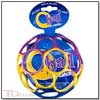
This rubbery, tri-colored ball is a staple for any child learning cognitive and social skills and developing fine- and gross-motor skills. Ideal for children with a special need, the ball is durable and has a skeletal structure that allows for easy catching. "Kids and teachers agree that Oballs are the easiest balls to catch and hold. The cool design already has won five awards for excellence and innovation, including an Oppenheim Toy Portfolio Gold Award and a Dr. Toy Best Vacation Products Award,” said Suzanne Silverglate, owner of Rhino Toys. — “Everybody buys it,” Dalene Lockhart, owner of Toy Town in Casper, Wyo., told TDmonthly in 2007. “Right now it is head and shoulders above others [in the infant/toddler category]. It's probably been that way for two years.” Retailers reported average monthly sales of five to 25 a month. — In summer 2008, four of 66 specialty retailers named the Oball as one of their top-selling gifts for babies. “We sell more of them because our store does gift wrapping and it makes a good topper,” said Jill Jernigan, owner of J. Christopher Toys in Jonesboro, Ark. ― Ask retailers about top-selling balls and the Oball is an answer that’s sure to come up, winning the graspable toy a TDmonthly Top Seller 2007 award. Six of 64 retailers named the Oball as a best-selling baby toy in March 2009, and two of 39 said the same a year later. “[It] is definitely the best-selling gift for babies,” stated John Naisbitt, owner of Thinker Things in Del Mar, Calif., in June 2009. ToyDirectory Product ID#: 456 (added 9/1/2004) . TD
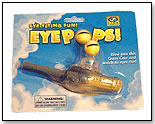
Blow into the tube and this alligator’s eyes pop into the air. It's perfect for children with respiratory diseases who need to build lung strength or for those with developmental delays who are learning cause and effect, oral exploration and social interaction. ToyDirectory Product ID#: 4014 (added 7/25/2005) . TD
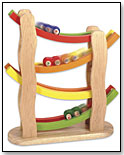
This simple system of brightly colored cars and ramps teaches a higher level of visual-motor integration than most toys used with two-year-olds. It also promotes fine-motor skills and cognitive development as well as sensory stimulation and social/coping skills — all the while introducing the rudimentary concepts of physics. ToyDirectory Product ID#: 4015 (added 7/25/2005) . TD
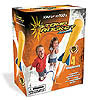
As a creative, educational action toy, it’s loads of fun — kids jump on the air bladder to launch a 9" all-foam rocket into the air. The Junior Stomp Rocket is used by science teachers to help children learn about trajectory, force and motion. It is also valued by psychologists, physical therapists, special-ed teachers and parents of children with special needs. “Stomp Rockets are recognized for their positive contribution to the lives of millions of children and adults around the world,” Frank Reed, of D & L Company, told TDmonthly. Awards: Top Toy of the Year 2005, Creative Child Magazine; Excellent Product 2005, iParenting Media. — “Our top selling flying toy is The Stomp Rocket Jr.,” confirmed Sallie Kashiwa, manager of Timbuk Toys in Denver, in October 2008. “We go through about four cases (40) a month.” — Six of 68 retailers said in fall 2008 that the Stomp Rocket is their best-selling flying toy. Holly Anvers, manager of Ages & Stages Toy Box in Golden, Colo., cited sales of about 40 units per month in late fall 2009. — Eighteen percent of 38 specialty retailers named Stomp Rockets an overall best-selling toy in July 2010. Scott Loveless, owner of Toys That Teach in Bothell, Wash., told TDmonthly in summer 2010 that his store sells “somewhere along the lines of 40 to 60” Stomp Rockets each month. “Stomp Rockets … are always a summer favorite.” — In autumn 2010, Marc Holcomb, owner of Toys & Co. In Greensboro, S.C., said he sold approximately 50 per month per store. “It's our #1 gift item,'' he told TDmonthly. ToyDirectory Product ID#: 1089 . TD
 Writer's Bio: Writer's Bio: Kara Revel is an MFA graduate of the University of California, Los Angeles. When not painting or dining with friends, she is a freelance writer and professional actor completing a book of nonfiction for Main Street Rag Publishers. Read more articles by this author
THIS BANNER IS AN AD:

• • • • • • • • • • • • • • • • • • • • • • • • | • • • • • • • • • • • • • • • • • • • • • • • • |
Back to TDmonthly's front page
|