A 3-year-old hands you an empty cup and waits for you to sip. A 4-year-old announces she is the doctor and you are the patient. A 5-year-old runs a whole grocery store from the living-room floor. Pretend play takes off between 3 and 5, and it is one of the easiest kinds of play to join. Here is what it practises, what the research can and can't say about it, free ways to play along, and seven toys that give the story a prop.
What pretend play looks like from 3 to 5
The CDC lists milestones that most children (75% or more) reach by a certain age. By 3, most children notice other children and join them to play. By 4, most pretend to be something else during play (teacher, superhero, dog) and ask to go play with children if none are around. By 5, most tell a story they heard or made up with at least two events, keep a conversation going with more than three back-and-forth exchanges, and follow rules or take turns when playing games with other children. You can hear all of those in a good game of house or store.
The CDC's play tips for these ages point straight at pretending. For 4-year-olds it suggests giving your child "toys or things that encourage his imagination, such as dress-up clothes, pots and pans to pretend cook, or blocks to build with," and joining in, "such as eating the pretend food he cooks." For 5-year-olds: "Encourage your child to pretend play. Help your child find items she can use to play dress up, school, or house." At 3, 4 and 5, the CDC also suggests reading stories or role play (pretend play) to help a child get ready for new places and people.
What it practises, and what the research can't say
When children pretend, they practise many things at once: using words to set up a scene, taking turns, playing a role, keeping a story going and using one object to stand for another. Zero to Three calls pretend play a valuable way to build skills like problem-solving and self-regulation, and notes that children use it to work through new or scary situations, like starting school or going to the doctor. It also points out that using a block as a phone is symbolic thinking, the same idea children later use when letters and numbers stand for sounds and amounts.
The American Academy of Pediatrics' report "The Power of Play" says developmentally appropriate play with parents and peers is "a singular opportunity to promote the social-emotional, cognitive, language, and self-regulation skills that build executive function." Its report on choosing toys says toys do the most good when they get caregivers and children playing together in play that is "rich in language, pretending, problem-solving, and creativity."
Be careful with bigger claims, though. A major review of the research on pretend play (Lillard and colleagues, 2013) concluded that "existing evidence does not support strong causal claims about the unique importance of pretend play for development." In plain terms: pretend play is one of many good ways young children play and practise skills, but no study shows that a pretend-play toy will make a child smarter or more social. What the evidence supports most is time spent playing together. So the toys below are props for that time, not lessons.
Free ways to join in
- Let your child be the boss of the story. Zero to Three suggests questions like "What will happen next?" and "Who should I be?"
- Raid the closet for dress-up clothes, as the CDC suggests. Old hats, shoes, scarves and bags all work.
- Pretend cook with pots, pans and wooden spoons, then eat what your child serves you.
- Turn a big cardboard box into a car, shop or house.
- Play out something new before it happens, like a first dentist visit or the first day of school.
- Don't rush to clean up. Zero to Three notes that children may want to return to the same castle or grocery store day after day.
A safety note before you shop: five of the seven picks below are graded 3 and up, and two listings carry a "CHOKING HAZARD, small parts, not for children under 3" warning. If you have a baby or toddler at home, store these up high after play. None of the picks uses batteries or magnets. The AAP's safe-toy tips start with "Read the label."
Toys that help: 7 props for pretend play
1. Melissa & Doug Let's Play House Grocery Cans, 10 cans (ages 3 to 6)

Ten stackable cardboard cans with removable plastic lids, per the listing. They stock a pretend pantry, a store shelf or a food drive, and they stack into towers between games. The listing shows about 4.8 stars from about 15,700 ratings.
Age and safety: manufacturer's recommended age 36 months to 6 years (minimum age 3). No warning text was shown on the listing. No batteries.
Price: $10.49 on Amazon (Amazon price checked Oct 29)
Pros:
- The cheapest pick, and the most-reviewed
- Works with any play kitchen or a cardboard-box store
Cons:
- Cardboard cans can dent or tear with rough play
2. Hape Egg Carton, 6 wooden eggs (ages 3 to 8)
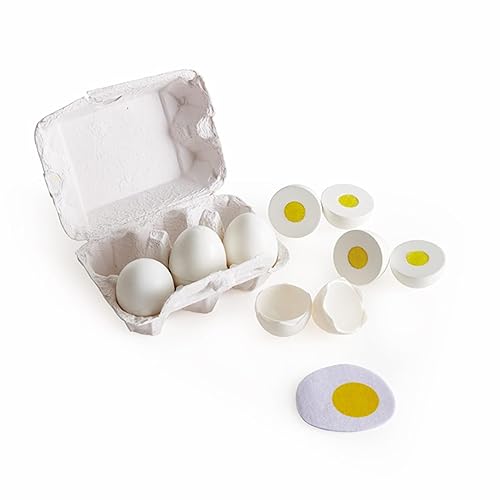
Three hard-boiled eggs with peel-off shells and three fried eggs in an egg-carton box, per the listing. Taking breakfast orders ("How do you want your eggs?") is an easy way into the CDC's suggestion to eat the pretend food your child cooks. The listing shows about 4.7 stars from about 4,600 ratings.
Age and safety: manufacturer's recommended age 36 months to 8 years. The listing warns: CHOKING HAZARD, small parts, not for children under 3 yrs. No batteries.
Price: $12.38 on Amazon (Amazon price checked Oct 29)
Pros:
- Peel-and-reveal eggs add a small surprise to kitchen play
- Wooden, and graded up to age 8
Cons:
- Small parts; keep away from younger siblings
- Only six eggs, so it is an add-on rather than a full set
3. Melissa & Doug Spray, Squirt & Squeegee Cleaning Play Set, 9 pieces (ages 3 to 6)

A caddy with a spray bottle, squirt bottle, scouring can, squeegee, cloth, scrub brush, sponge and a cleaning checklist, per the listing. The bottles really spray water, and the listing says not to use real cleaning products. Playing at chores fits the CDC's 5-year milestone of doing simple chores at home, like clearing the table. The listing shows about 4.8 stars from about 3,560 ratings.
Age and safety: manufacturer's recommended age 36 months to 6 years. The listing warns: CHOKING HAZARD, small parts, not for children under 3 yrs. It also shows a California Proposition 65 notice. No batteries.
Price: $18.89 on Amazon (Amazon price checked Oct 29; the page showed "Only 13 left in stock")
Pros:
- Real spraying gives pretend chores a real result
- Doubles as outdoor water play
Cons:
- Water play indoors means towels nearby
- Small parts; keep away from younger siblings
4. Fisher-Price Preschool Pretend Play Medical Kit, 7 pieces (3 years and up)

A fabric doctor's bag with a stethoscope, blood pressure cuff with a spinning gauge, thermometer that flips from "sick" to "well", otoscope, syringe and bandage, per the listing. Playing doctor is one of the classic ways children rehearse a visit before it happens, which is the kind of role play the CDC suggests for getting ready for new places. The listing shows about 4.6 stars from about 1,180 ratings.
Age and safety: manufacturer's recommended age 3 years and up. No warning text was shown on the listing, and the listing says no battery is required.
Price: $17.65 on Amazon (Amazon price checked Oct 29)
Pros:
- Everything packs into the bag
- Moving parts (pump, gauge, flip thermometer) without batteries or sounds
Cons:
- Seven pieces, fewer than larger doctor sets
5. Melissa & Doug Take-Along Tool Kit, 24 wooden pieces (ages 3 to 6)

A wooden toolbox with a child-size hammer, wrench and screwdriver plus wooden nails, screws and boards with holes, per the listing. Fixing the "broken" table or building a pretend birdhouse mixes role play with putting things together, which the CDC suggests for 5-year-olds. The listing shows about 4.7 stars from about 10,200 ratings.
Age and safety: manufacturer's recommended age 36 months to 6 years (minimum age 3). The listing's safety field reads "No Warnings Required", but the set includes small wooden nails and screws, so treat it as a 3+ toy. It also shows a California Proposition 65 notice. No batteries.
Price: $18.91 on Amazon (Amazon price checked Oct 29)
Pros:
- Sturdy wood, with more than 10,000 ratings
- Gives builders a role to play
Cons:
- Loose nails and screws are easy to lose
6. Melissa & Doug Animal Hand Puppets, 2 sets of 4 (ages 2 to 6 on the listing)

Eight fabric puppets in two sets: a sheep, cow, pig and horse, and a tiger, monkey, elephant and giraffe, sized for children's and most adults' hands, per the listing. Putting on a puppet show is a natural way to tell a story with at least two events, a CDC 5-year milestone. The listing shows about 4.7 stars from about 1,960 ratings.
Age and safety: manufacturer's recommended age 24 months to 6 years (the bullets say ages 2 to 8). No warning text was shown on the listing. Washable fabrics, per the listing. No batteries.
Price: $29.99 on Amazon (Amazon price checked Oct 29)
Pros:
- Eight characters for a parent and child to share
- Graded from 2, so younger siblings can join in
Cons:
- The most expensive pick here
7. JC Toys Boutique Folding Umbrella Doll Stroller (ages 2 to 14)

A 21-inch folding stroller with a metal frame and a doll seat belt that fits dolls up to 18 inches, per the listing. Taking a doll or stuffed animal for a walk, buckling it in and putting it down for a nap is caregiving play that can stretch across a whole afternoon. The listing shows about 4.8 stars from about 1,070 ratings.
Age and safety: manufacturer's recommended age 24 months to 14 years. No warning text was shown on the listing. It is a doll stroller, not a walker or a ride-on. No batteries.
Price: $19.99 on Amazon (Amazon price checked Oct 29; the page showed "Only 7 left in stock")
Pros:
- Folds flat and wipes clean
- Long age range
Cons:
- Doll not included
- Low stock when we checked
More by age
Pretend-play picks also appear in our Best Toys for 4-Year-Olds 2026 and Best Toys for 5-Year-Olds 2026, and in the Holiday Gift Guide for Ages 3 to 5. For younger pretenders, see Best Toys for 2-Year-Olds 2026 and Best Toys for 18-Month-Olds 2026. For another kind of play that grows from the toddler years, read What Toddlers Learn From Stacking and Building Toys.
If you have questions about development
Every child grows at their own pace, and some children pretend more than others. If your child is not meeting one or more milestones, has lost skills they once had, or you have other concerns, talk to your pediatrician. The CDC also lists each state's early intervention contacts at cdc.gov/FindEI.
Sources:
#ad As an Amazon Associate, TDmonthly earns from qualifying purchases. Prices and availability are as of Oct. 29, 2026 and may change.